

White-Label OTT Platform: How It Works and When to Build One
A white-label OTT platform gets you to market in weeks, not months. Here’s how it works, what to look for, and when it’s the right call.

Ayoze Vera Arbelo, Tech Lead
26/01/2026 • 7 min read
This decision affects everything from launch timeline to long-term scalability. Here’s how to get it right.
When streaming and sports platforms come to us with greenfield projects or major rebuilds, the Next.js vs React question surfaces early.
It sounds like a developer decision. It isn’t.
This choice directly impacts your time to market and your subscriber acquisition costs. It determines how painful it will be to swap providers when rights deals change.
After building OTT platforms across sports, entertainment, and live events, we’ve developed a clear framework for making this decision. This article shares that framework so you can pressure-test your own technical direction, whether you’re building in-house, evaluating vendors, or inheriting a platform that needs modernisation.
Before comparing technologies, let’s establish what matters. Streaming platforms and OTT services share specific architectural requirements that generic web applications don’t face.
With these requirements clear, let’s examine how each framework delivers.
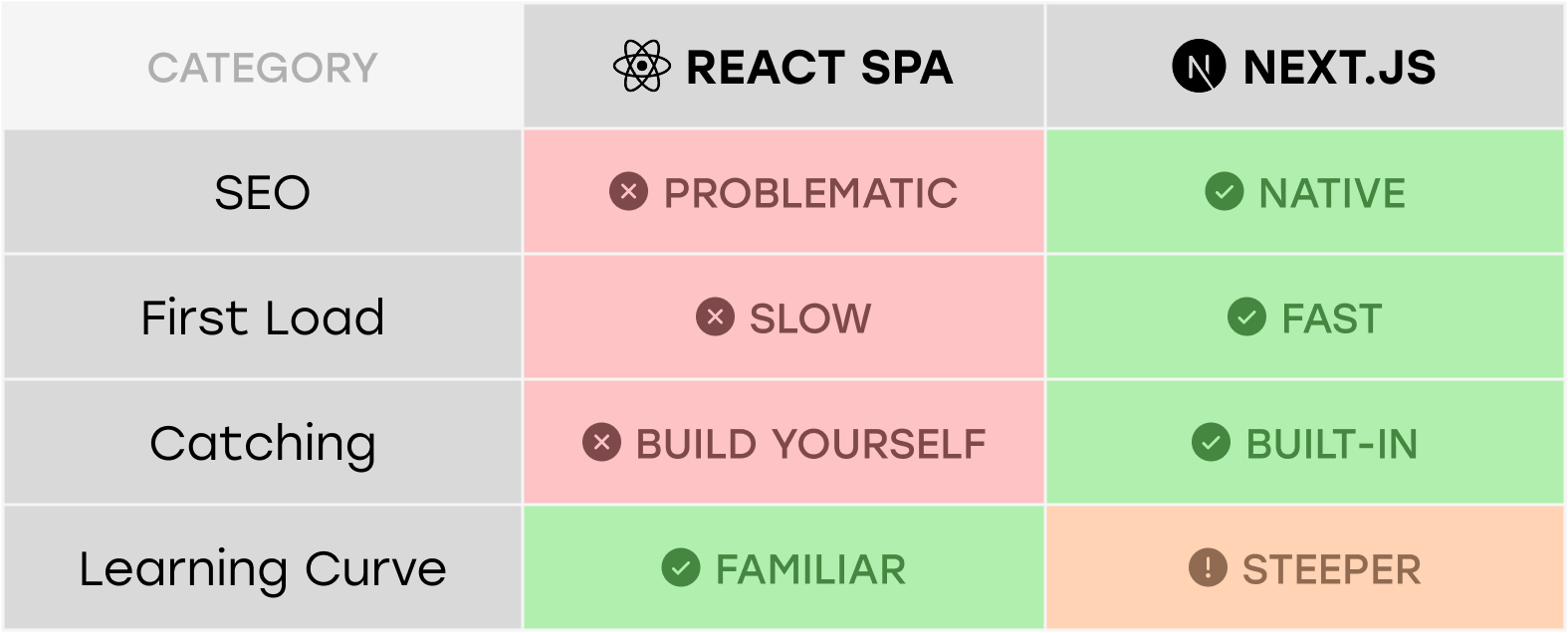
In the Next.js vs React debate, pure React keeps things simple. Your server delivers static files (JavaScript, CSS, assets) and steps aside. Everything else happens in the user’s browser.
Where this works well:
Where streaming platforms hit problems:
The bottom line: Pure React works for platforms where SEO doesn’t matter, where your user base has modern devices, and where you have engineering bandwidth to build custom caching infrastructure. For most video streaming platforms, these constraints become painful quickly.
The React SEO problems described above aren’t theoretical. We’ve seen OTT platforms struggle to index their content catalogues for months after launch. The root cause is architectural: single-page applications render content in the browser, but search crawlers prefer content that’s already rendered when they arrive.
There are workarounds: prerendering services, dynamic rendering for bots, hybrid approaches. But they add complexity and failure points. You’re patching around a fundamental limitation.
This is where Next.js changes the equation.
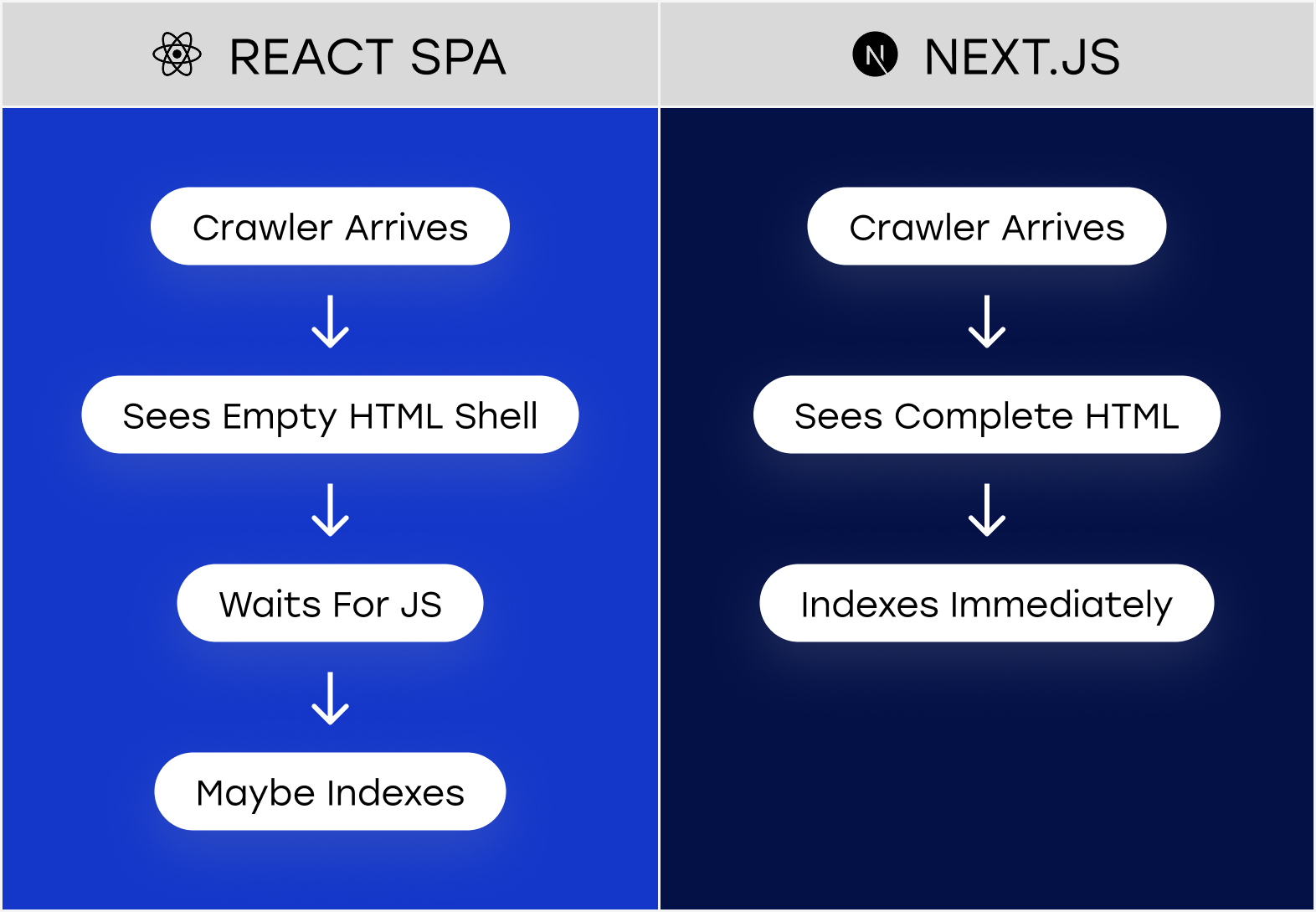
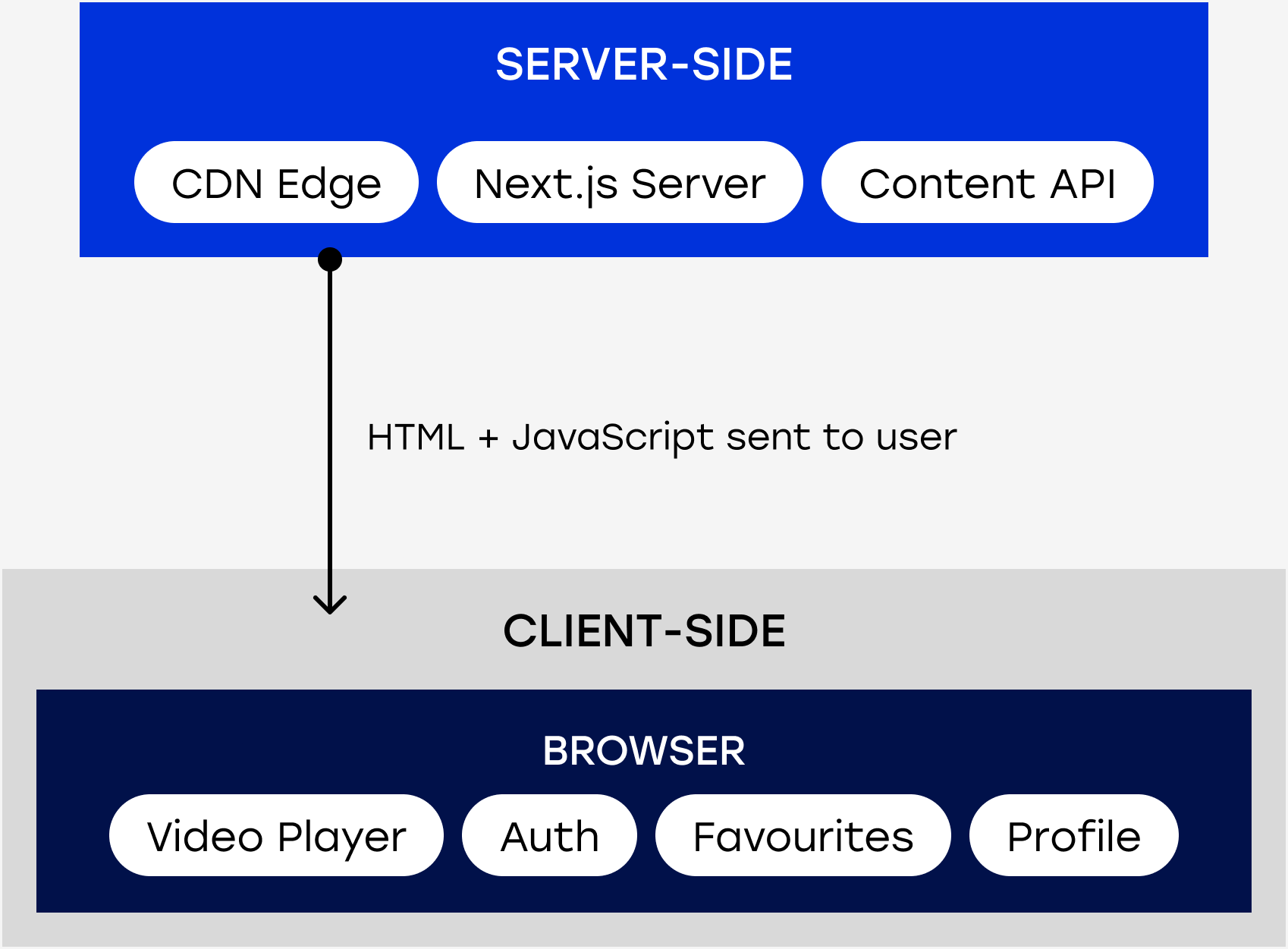
Next.js adds a server-side layer to React, enabling multiple rendering strategies: static generation, server-side rendering, and client-side rendering, mixed as needed across your application.
Where this transforms OTT platform development:
Where teams need to adapt:
The bottom line: Next.js addresses the specific challenges streaming platforms face while maintaining React’s component model and ecosystem. The additional complexity is justified by the capabilities gained.
So where does the Next.js vs React decision land for OTT platforms?
For streaming and sports platforms with meaningful SEO requirements and global audiences, Next.js is the stronger choice.
Here’s the reasoning:
For teams moving forward with Next.js for OTT platform development, these principles have served us well:
Your movie detail pages, series pages, and league pages don’t need real-time rendering. Generate them at build time or on first request, cache globally, and set revalidation intervals that match your content update frequency. For most platforms, hourly revalidation is more than sufficient.
Video players, authentication flows, profile management, favourites, watch history: these are browser concerns. Mark them explicitly as client components. They’ll hydrate after the initial server-rendered shell displays, giving users instant content visibility while interactivity loads.
Content availability varies by region. Running this logic at the edge reduces latency and keeps your origin server focused on what only it can do.
When your content library updates, you need surgical cache invalidation: refresh the affected pages without regenerating everything. Build your CMS integration with this in mind.
It’s tempting to move significant logic server-side. Resist this for anything that doesn’t genuinely benefit from server execution. The goal is fast initial render, not server-side application logic. Most of your platform’s intelligence should still live in client components where it’s easier to debug and test.
Framework decisions feel technical, but their consequences are commercial. The choice between React and Next.js affects launch speed and content discoverability. It shapes infrastructure costs and long-term adaptability.
For OTT platforms where organic discoverability matters and global audiences expect instant loads, Next.js provides capabilities that pure React doesn’t match without substantial custom engineering.
The learning curve is real. So is the added complexity. But for streaming and sports platforms specifically, the trade-off favours Next.js.
2Coders builds streaming and sports platforms for clients across Europe and North America. If you’re evaluating architecture for a new platform or modernising an existing one.
The learning curve is real. So is the added complexity. But for streaming and sports platforms specifically, the trade-off favours Next.js.
Not by default. React as a single-page application serves crawlers an empty HTML shell and a JavaScript bundle. Google can execute JavaScript, but it’s slower and less reliable than crawling pre-rendered HTML and smaller search engines may skip it entirely. For platforms where organic discoverability drives subscriber acquisition, that’s a real cost. React can be made more SEO-friendly with prerendering services or dynamic rendering, but those are workarounds for a fundamental architectural limitation. Next.js solves this at the framework level.
Two compound each other. First, content pages – your movie pages, series pages, match centre pages – may take weeks to index after launch, if they index at all. Second, your JavaScript bundle grows with every feature you add. As the bundle gets heavier, first load slows down, and a slow first load hurts both conversions and search rankings. For a streaming platform trying to rank for “watch [title] online” or “stream [league] live,” these aren’t edge cases. They’re the core use case.
Yes, and it goes further than basic SSR. For OTT platforms specifically, Incremental Static Regeneration is usually the better fit – content catalogue pages are generated statically and served from cache globally, with periodic revalidation when your library updates. This means most requests never touch your origin server. Live event pages or anything requiring real-time data can use SSR selectively. The point is you’re choosing the right rendering strategy per page type, rather than applying one approach to everything.
A white-label OTT platform gets you to market in weeks, not months. Here’s how it works, what to look for, and when it’s the right call.
Next.js vs React for streaming platforms: which wins on SEO, load speed, and scale? Here’s the framework we use after 180+ OTT builds.

The hero banner had no image. 200K fans saw an error screen. This is the streaming testing model that prevents it.
We’ve built 180+ streaming apps across mobile and Connected TV, including a gaming streaming platform that needed to survive extreme live event traffic. QA architecture for CMS-driven platforms is something we think about a lot right now. If you’re working through the same questions, we’re happy to compare notes.