Next.js vs Pure React for Web OTT Platforms
This decision affects everything from launch timeline to long-term scalability. Here’s how to get it right.
When streaming and sports platforms come to us with greenfield projects or major rebuilds, one question surfaces early: pure React or Next.js?
It sounds like a developer decision. It isn’t. This choice directly impacts your time to market and your subscriber acquisition costs. It determines how painful it will be to swap providers when rights deals change.
After building OTT platforms across sports, entertainment, and live events, we’ve developed a clear framework for making this decision. This article shares that framework so you can pressure-test your own technical direction, whether you’re building in-house, evaluating vendors, or inheriting a platform that needs modernisation.
What streaming platform architecture actually requires
Before comparing technologies, let’s establish what matters. Streaming platforms and OTT services share specific architectural requirements that generic web applications don’t face.
- Discoverability drives subscriber acquisition. Your content pages need to rank. When someone searches “watch [title] online” or “stream [league] live,” your platform should appear. Poor SEO visibility means higher customer acquisition costs, because you’re paying for ads to compensate for organic traffic you’re not getting.
- First impressions happen in milliseconds. Users decide whether your video on demand platform feels “premium” or “sluggish” within seconds of landing. A slow initial load creates friction right at the moment you’re trying to convert browsers into subscribers. This is especially true on mobile and smart TVs.
- Scale isn’t linear. A major match. A premiere. A viral moment. Traffic surges without warning. Your architecture needs to handle 50,000 concurrent users hitting the same content page without your servers buckling or your costs exploding.
- The vendor mix shifts constantly. Video player providers, authentication services, payment processors, CDNs: the best choice today may not be the best choice in eighteen months. Your streaming platform architecture should allow module swaps without platform rebuilds.
- Most interactions are client-side, but first load can’t be. Once users are watching content, everything happens in their browser: playback controls, favourites, profile switching. But that first page load needs to be fast and indexable.
With these requirements clear, let’s examine how each framework delivers.
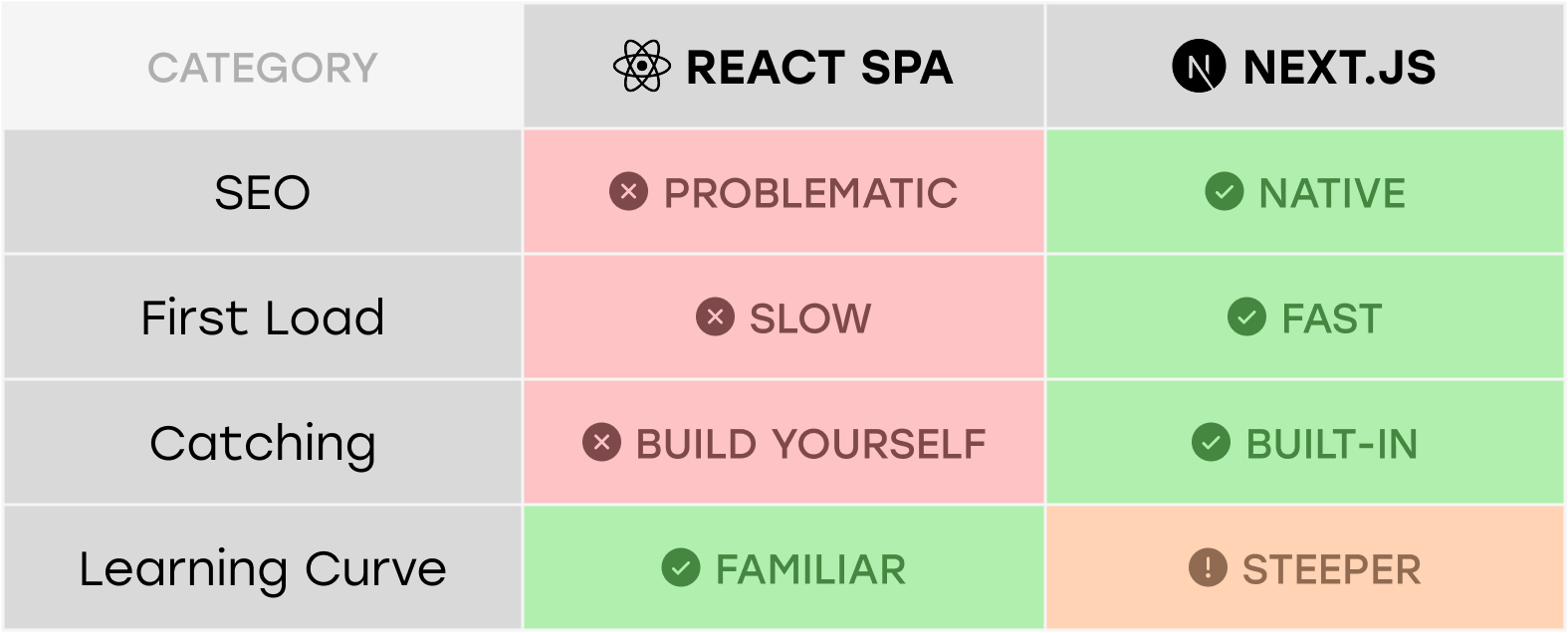
React vs Next.js for streaming platforms: feature comparison
React for streaming: Where SPAs fall short
React as a single-page application keeps things simple. Your server delivers static files (JavaScript, CSS, assets) and steps aside. Everything else happens in the user’s browser.
Where this works well:
- Minimal infrastructure complexity. No server-side rendering means no server compute to manage. Your hosting costs stay predictable and low.
- Developer familiarity. Most frontend teams know React deeply. There’s no learning curve for SSR patterns, hydration strategies, or server component boundaries.
- Debugging clarity. When something breaks, it broke in the browser. One environment to investigate.
- Maximum flexibility. No framework opinions to navigate. You architect everything exactly as you want it.
Where streaming platforms hit problems:
- SEO is genuinely compromised. Search crawlers receive an empty HTML shell and a JavaScript bundle. While Google’s crawler can execute JavaScript, it’s slow, resource-intensive, and often deprioritised. Your content pages may take weeks to index properly, if they index at all. Smaller search engines may never see your content.
- Initial load times grow with your platform. Every feature adds to the JavaScript bundle that users must download and execute before seeing anything. For feature-rich OTT platforms, this bundle gets heavy. First load suffers.
- You build your own caching layer. Service workers, HTTP cache headers, client-side state management: it’s all possible, but you’re engineering it from scratch.
- Lower-end devices struggle. Not every user is on the latest iPhone. Smart TVs and budget Android devices need to parse and run your entire application. You’re pushing compute costs onto your users’ devices.
The bottom line: Pure React works for platforms where SEO doesn’t matter, where your user base has modern devices, and where you have engineering bandwidth to build custom caching infrastructure. For most video streaming platforms, these constraints become painful quickly.
Solving React SEO problems with server-side rendering
The React SEO problems described above aren’t theoretical. We’ve seen OTT platforms struggle to index their content catalogues for months after launch. The root cause is architectural: single-page applications render content in the browser, but search crawlers prefer content that’s already rendered when they arrive.
There are workarounds: prerendering services, dynamic rendering for bots, hybrid approaches. But they add complexity and failure points. You’re patching around a fundamental limitation.
This is where Next.js changes the equation.
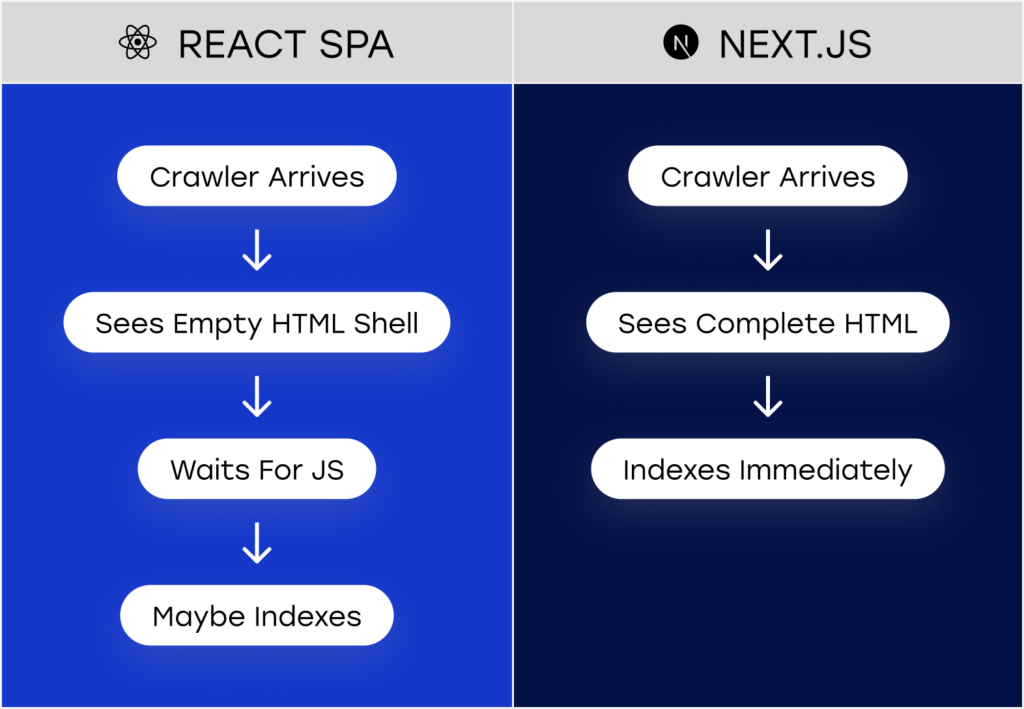
How search crawlers see React SPAs vs Next.js pages
Next.js for streaming platforms: The advantages
Next.js adds a server-side layer to React, enabling multiple rendering strategies: static generation, server-side rendering, and client-side rendering, mixed as needed across your application.
Where this transforms OTT platform development:
- SEO works natively. Content pages render as complete HTML before reaching the browser. Crawlers see your titles, descriptions, metadata, and content immediately. No JavaScript execution required. Your movie and match pages become indexable from day one.
- Fast first load without sacrificing interactivity. The initial content shell renders on the server for instant display. Interactive elements (your video player, profile switcher, favourites functionality) hydrate client-side afterward. Users see content immediately while rich functionality loads in the background.
- Incremental Static Regeneration handles content catalogues well. Your library of titles doesn’t need real-time rendering. Generate pages statically, serve them from cache globally, and revalidate periodically (hourly, daily, your choice). Most requests never touch your origin server. When your catalogue updates, targeted cache invalidation refreshes only what changed.
- Layered caching out of the box. Data caching for API responses, full route caching for rendered pages, router caching for client-side navigation. These layers work together automatically. You’d spend months building what the framework provides natively.
- Edge deployment distributes load globally. Rendering logic can run on CDN nodes close to users rather than on centralised servers. A user in São Paulo gets their page rendered in São Paulo. Latency drops; origin server load stays minimal.
- The server-client boundary encourages clean architecture. You must be explicit about what runs where. For streaming platforms, this maps naturally: content fetching happens server-side for speed, while video playback and user interactions stay client-side where they belong.
Where teams need to adapt:
- More concepts to master. Server components, client components, SSR, SSG, ISR, hydration: there’s a learning curve for teams coming from pure SPA development.
- Debugging spans two environments. Issues can originate on the server, the client, or in the handoff between them. Investigation requires comfort with both contexts.
- Framework evolution is Vercel’s call. You’re adopting their roadmap. For most teams, this is fine; Vercel moves the framework forward aggressively. But it’s a dependency to acknowledge.
- Over-engineering becomes tempting. The framework offers many capabilities. Not every page needs server rendering. Discipline is required to keep architecture proportionate to requirements.
The bottom line: Next.js addresses the specific challenges streaming platforms face while maintaining React’s component model and ecosystem. The additional complexity is justified by the capabilities gained.
Our recommendation for OTT platform development
For streaming and sports platforms with meaningful SEO requirements and global audiences, Next.js is the stronger choice.
Here’s the reasoning:
- Discoverability can’t be retrofitted easily. If subscriber acquisition matters, you need content pages that search engines can index reliably. Next.js delivers this natively. With pure React, you’d be adding prerendering services, hoping crawlers execute JavaScript correctly, accepting delayed or incomplete indexing. You’re fighting React SEO problems that Next.js simply doesn’t have.
- First impressions compound over time. Every user who bounces because your initial load felt slow is a subscriber you didn’t convert. Next.js’s hybrid rendering solves a problem that pure SPAs can’t address without significant custom engineering.
- The caching requirements point to Next.js too. ISR is tailor-made for video on demand platforms: a content catalogue that updates periodically but doesn’t need real-time rendering. Most requests serve cached content. The server stays light.
- Your SDK architecture maps cleanly onto Next.js’s component model. We build streaming platforms with swappable modules (video players, auth providers, payment processors, content fetchers) using consistent interfaces. These modules are naturally client-side concerns. Server components handle initial data loading; client components handle interactivity. The framework’s structure mirrors what good streaming platform architecture looks like anyway.
Implementation principles for Next.js streaming projects
For teams moving forward with Next.js for OTT platform development, these principles have served us well:
- Generate content pages statically with ISR revalidation. Your movie detail pages, series pages, and league pages don’t need real-time rendering. Generate them at build time or on first request, cache globally, and set revalidation intervals that match your content update frequency. For most platforms, hourly revalidation is more than sufficient.
- Build all interactive SDK modules as client components. Video players, authentication flows, profile management, favourites, watch history: these are browser concerns. Mark them explicitly as client components. They’ll hydrate after the initial server-rendered shell displays, giving users instant content visibility while interactivity loads.
- Use edge runtime for geolocation and personalisation logic. Content availability varies by region. Running this logic at the edge reduces latency and keeps your origin server focused on what only it can do.
- Design for cache invalidation from day one. When your content library updates, you need surgical cache invalidation: refresh the affected pages without regenerating everything. Build your CMS integration with this in mind.
- Keep server components thin. It’s tempting to move significant logic server-side. Resist this for anything that doesn’t genuinely benefit from server execution. The goal is fast initial render, not server-side application logic. Most of your platform’s intelligence should still live in client components where it’s easier to debug and test.
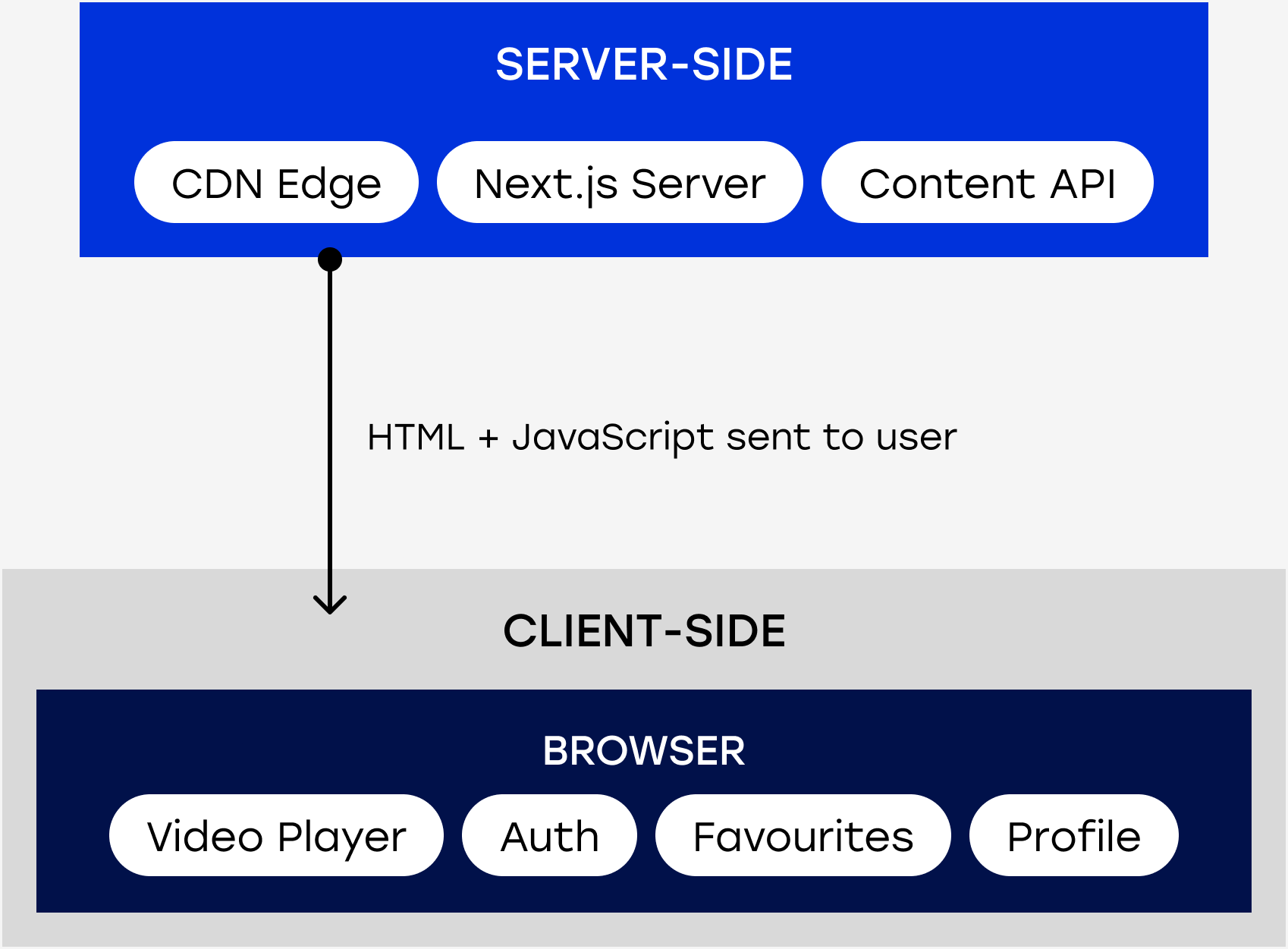
Next.js streaming platform architecture: server-side vs client-side
Final thought
Framework decisions feel technical, but their consequences are commercial. The choice between React and Next.js affects launch speed and content discoverability. It shapes infrastructure costs and long-term adaptability.
For OTT platforms where organic discoverability matters and global audiences expect instant loads, Next.js provides capabilities that pure React doesn’t match without substantial custom engineering.
The learning curve is real. So is the added complexity. But for streaming and sports platforms specifically, the trade-off favours Next.js.
2Coders builds streaming and sports platforms for clients across Europe and North America. If you’re evaluating architecture for a new platform or modernising an existing one.