







Someone on your board went to a Premier League match last month. On the way out, they opened the club’s app, and now they want one just like it, with a budget that wouldn’t cover a corner of it and a deadline set for next season. Every quote you get back rests on the same assumption: you’ll pay to build, from scratch, the exact foundation a hundred clubs have already built before you. Most of that money never reaches anything a fan will actually see.
Here’s why that keeps happening, what it actually costs, and how the smartest organisations are breaking the cycle.
Key findings in 60 seconds
- Most of a sports app's early budget disappears into infrastructure fans never consciously notice: data normalisation, entity mapping, live-event processing, cross-platform parity and QA.
- The live layer is what makes sports apps expensive. A corrected goal can't leave two screens showing different scores, a postponed fixture has to ripple through schedules and notifications on its own, and spoiler-free mode has to work across devices — none of that is standard app plumbing.
- Even the world's biggest sports apps ship with patchy basics. If they can't get it right building bespoke, a smaller club or federation has no business attempting the same groundwork on a fraction of the money.
- Pendo found that roughly 80% of features across 615 software products go rarely or never used. In sports apps the risk is the opposite: the features that would matter most never get built at all, because the foundation ate the budget first.
The money pit: infrastructure fans never see
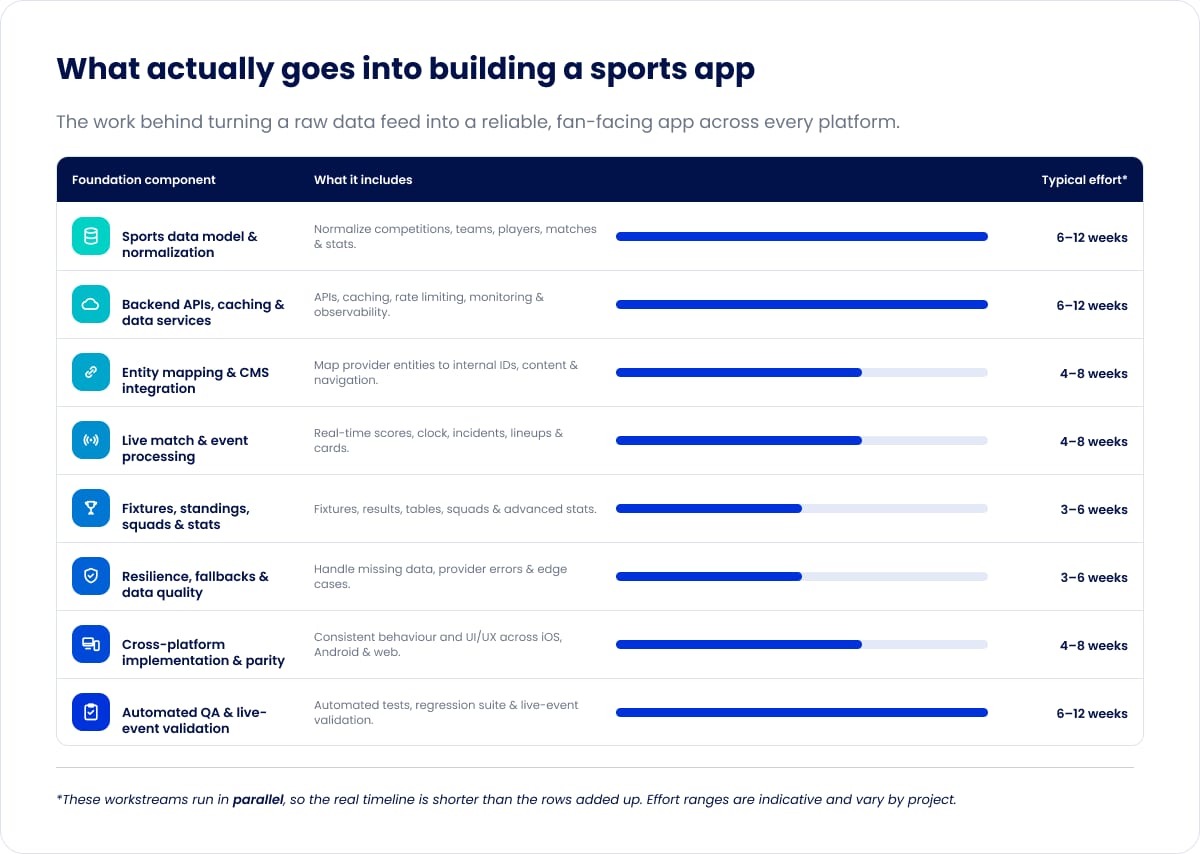
Data normalization, backend services and caching, entity mapping, live-event processing, cross-platform build and QA: this is where a large part of a sports app’s engineering effort disappears, and almost none of it is something a supporter will consciously notice.
We’ve watched this across hundreds of projects. A club or federation signs off, twelve months later it ships with a decent news feed and a match centre that mostly holds up, and nobody asks where the budget went. It went into the plumbing every sports app needs and every sports app tends to rebuild from scratch.
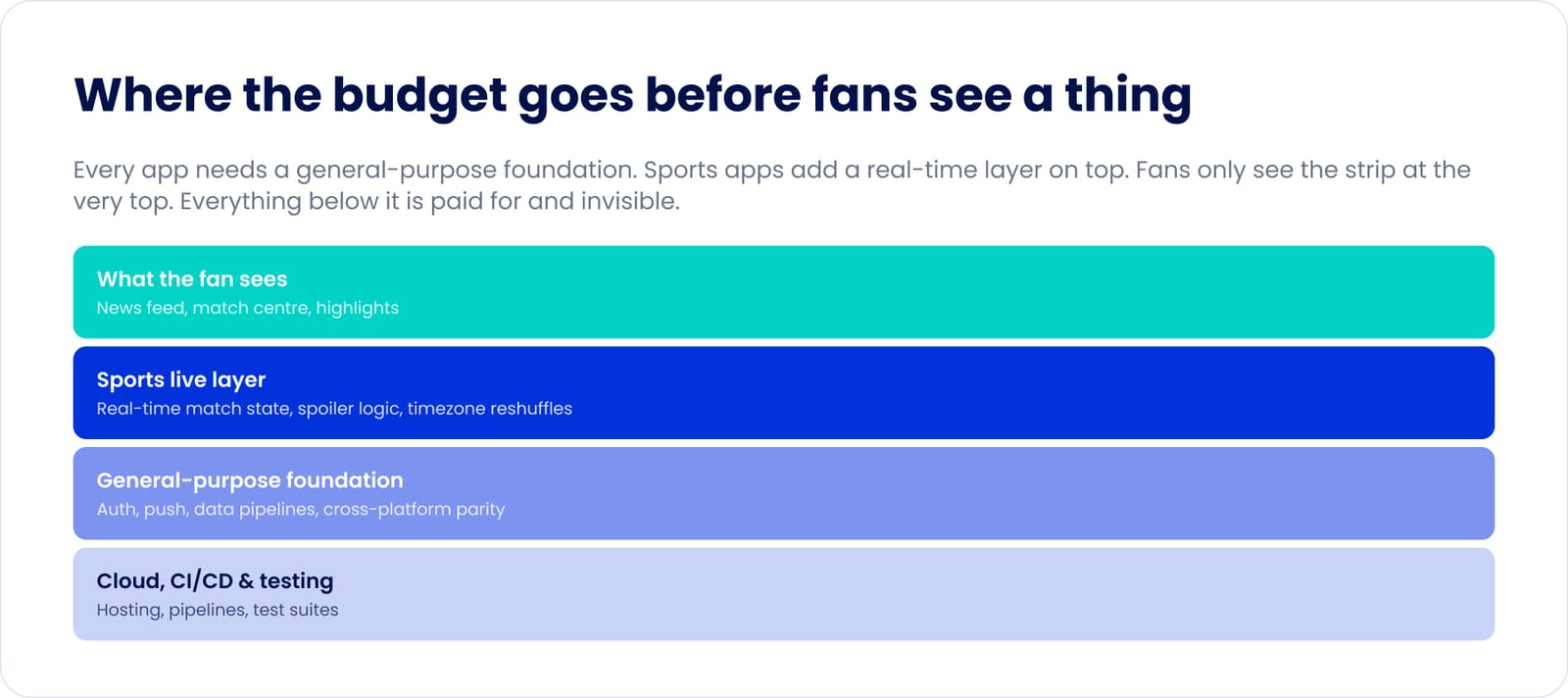
Sports apps also carry weight most software doesn’t: a live layer. A match status has to reach every screen and notification within seconds. Scores update mid-scroll, schedules cross time zones and reshuffle the moment a fixture moves, and features that look simple on their own start to collide. A feed refreshing mid-match can’t freeze the video. A corrected goal can’t leave two screens showing different scores. A postponed fixture has to ripple through schedules, notifications and editorial content without anyone touching it by hand. And spoiler-free mode has to know what a fan hasn’t watched yet, across devices, without a push notification giving the result away.
All of this starts with your data provider. The global industry leader for sports data is Stats Perform, whose live Opta Data feeds are ready for consumption by clients as soon as a contract is signed: fixtures, lineups, scores and in-game player stats are all synchronised and clean from day one. That same data also powers video. Stats Perform’s Opta Pulse syncs live match data to highlights, so they can slot straight into a match centre or timeline.
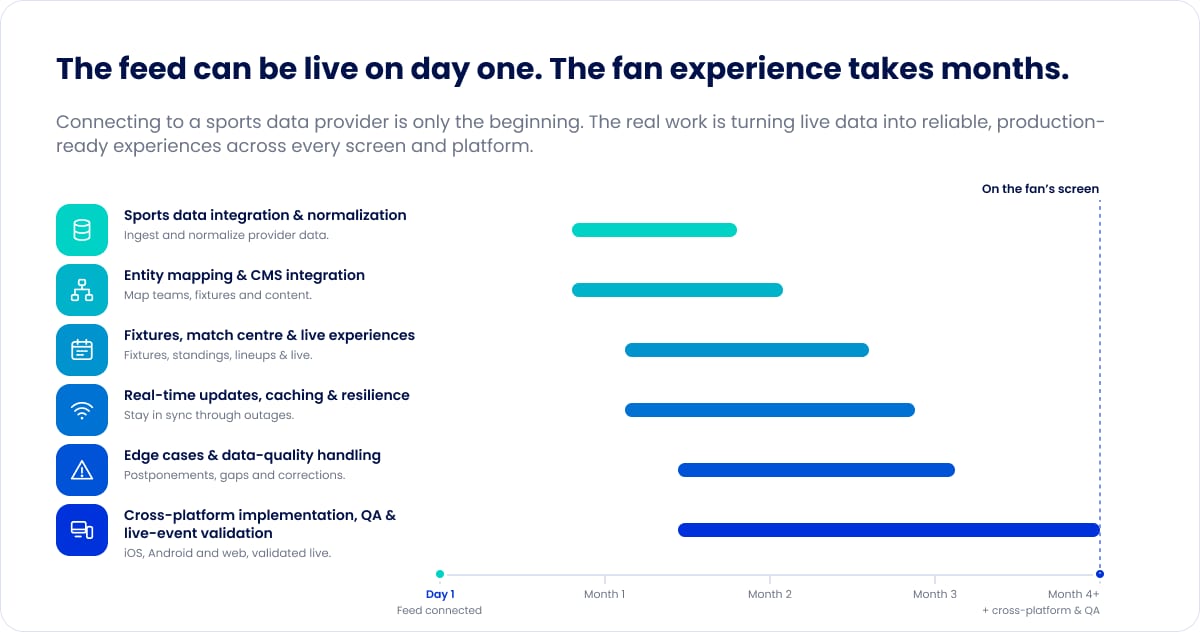
The months of work come after that, in the gap between feed and screen:
- Provider data has to be normalized into the product’s own model.
- Competitions, teams and fixtures have to map onto content and navigation that make sense to a fan who’s never heard of the Copa del Rey.
- Live events have to update reliably on every screen at once, APIs need caching and a fallback for when data runs late, and the whole thing has to behave the same on iOS, Android and web.
None of that is a problem with the data. It’s the engineering that turns a clean feed into something a fan actually uses, and most organisations end up building it over again as if no one had done it before.
The real cost: six months before anything a fan will love gets built
That last mile is expensive in a way nobody budgets for. Across 180-plus projects we’ve shipped, the pattern holds: a large share of the early roadmap goes to foundation work before a team can put its full attention, and its budget, into the experiences that actually differentiate the product.
And these aren’t neat, sequential phases. Data modelling, backend services, entity mapping, live-event processing, cross-platform implementation and QA overlap for weeks or months. Features can and do reach fans during that period. The problem is how much engineering capacity is still being spent solving the foundation rather than creating something distinctive.
The cost of that wait shows up in what gets cut. Pulling apart four of the world’s biggest sports apps for our UX Rerun series, even they had patchy basics: one handled spoilers on iOS but not Android, another let you share from the news feed but not the match centre, the kind of gap a fan clocks in five minutes.
If teams with serious budgets can’t get this right building bespoke, a second-tier club or county board has no business attempting the same groundwork on a fraction of the money.
The model doesn’t scale down.
And the money that does get spent often builds the wrong things. Pendo found that roughly 80% of features across 615 software products go rarely or never used. In sports apps the risk runs the other way.
The features that would matter most never get built at all, because the base layer ate the budget first.
The larger the organisation, the more times that same base layer gets built. A league with sixty member clubs, or a federation with half a million members, can end up paying repeatedly for variations of the same foundational capabilities, with different teams and suppliers implementing similar integrations in parallel.
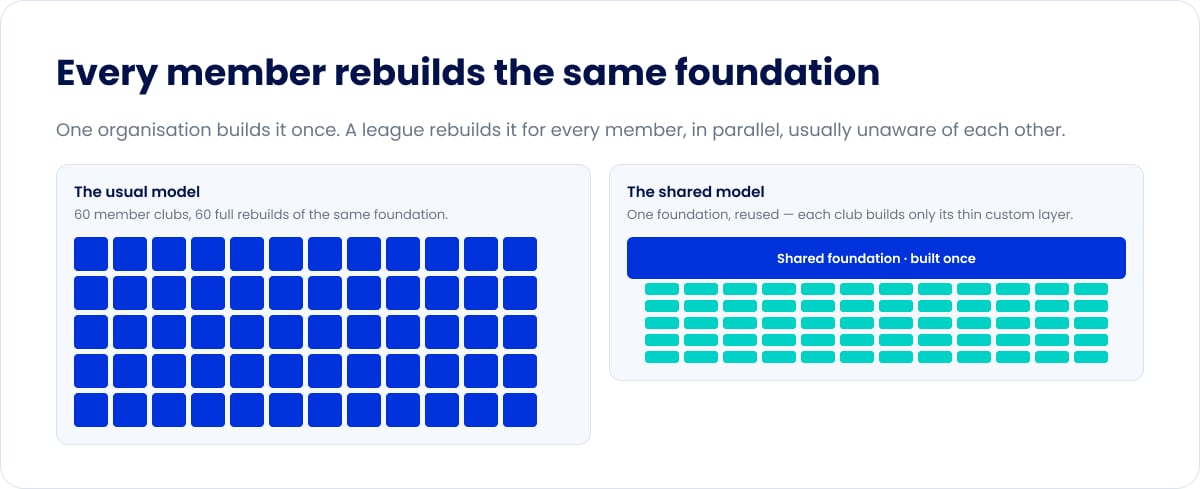
The fix: stop rebuilding the foundation
The app itself isn’t the problem. Every sports organisation needs a fan app: fans expect one, sponsors want the first-party data instead of leaving it with Meta and Google, and broadcasters need second-screen engagement to hold attention. What varies between organisations is how they split that budget: how much goes to the engineering every app needs, and how much to the engineering that makes yours worth opening.
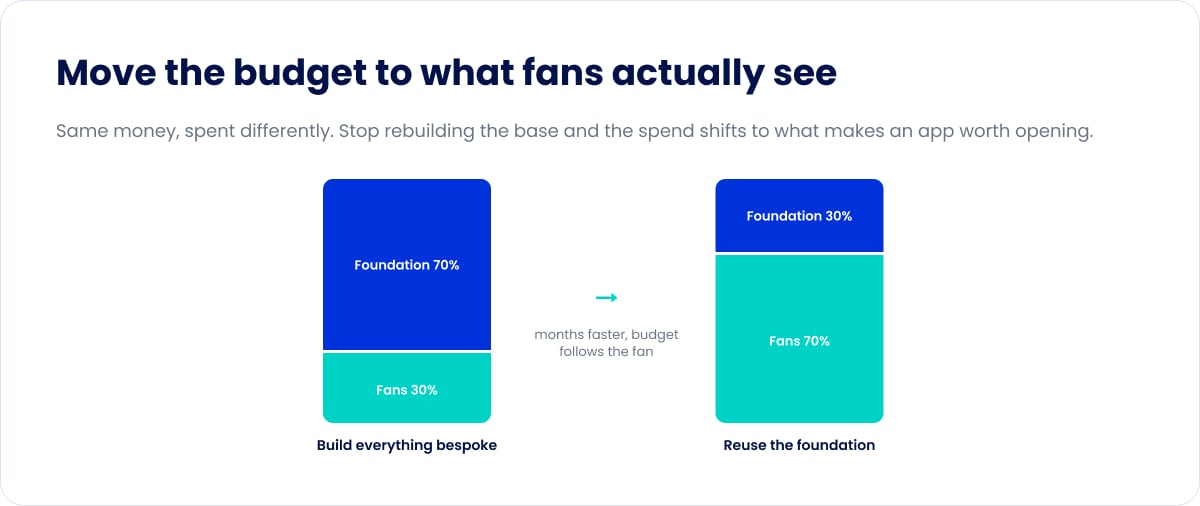
The teams that draw a hard line between the two move months faster than everyone else. Starting from a reusable foundation means scores, fixtures, match centres and highlights can reach fans much earlier, while more of the roadmap, engineering capacity and budget remain available for the experiences unique to that organisation and its supporters.
The groundwork is close to identical for almost everyone. Sports data still needs to be normalized, mapped, cached, monitored, tested and delivered consistently across platforms. But none of that has to be reinvented from scratch every time a new club or federation launches an app.
What you build on top of that foundation is the part your fans will notice: the editorial voice, the matchday experience, personalization, video, community and loyalty, the moments that turn an installed app into a habit.
The sports data can be ready on day one. The opportunity is to stop spending the months that follow rebuilding the same last mile, and start spending them on the fan.
Frequently asked questions
How much does it cost to build a sports app?
Sports app development cost varies widely depending on scope, but the hidden driver is infrastructure. Authentication, push notifications, live data integration, timezone logic, and cross-platform parity typically consume the first six months and a significant share of the total budget before any fan-facing features are built.
Why do sports apps take so long to develop?
The live-data layer unique to sports — real-time scores, fixture changes, spoiler management, and cross-device synchronisation — adds months of engineering on top of standard app infrastructure. Every organisation rebuilds these systems from scratch, even though the underlying problems are nearly identical across clubs and federations.
What is invisible infrastructure in sports app development?
Invisible infrastructure refers to the backend systems fans never see but every sports app requires: user authentication, push notification pipelines, live data ingestion and mapping, timezone resolution, competition hierarchy navigation, and cross-platform feature parity between iOS, Android, and web.
Should a sports club build a custom app or use a platform?
For most clubs and federations, the foundation — authentication, data pipelines, match centres, push infrastructure — is nearly identical. Building it custom means spending months and budget on solved problems. A platform approach lets organisations start where the product gets interesting: the fan experience, editorial voice, and matchday features that differentiate one app from another.